The Proof Stage
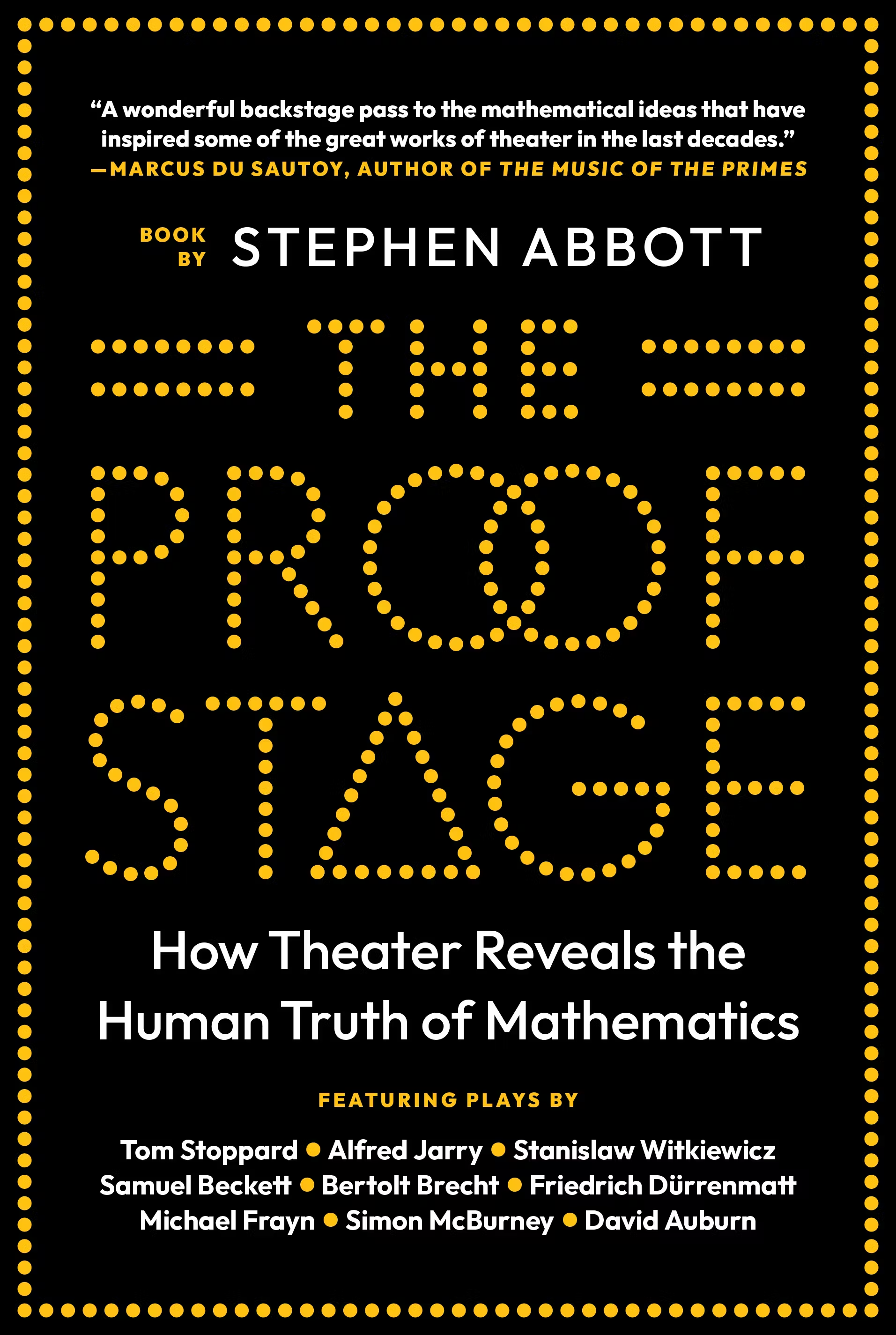
At first glance, mathematics and theatre seem to sit at opposite ends of human experience — one governed by cold logic, the other by emotion. Stephen Abbott, the mathematician behind The Proof Stage, spent years living in both worlds: what started as a favour — talking to a colleague from the drama department and her cast about a new play — slowly pulled him in deeper, until theatre became not just a side interest but an essential part of how he sees the world. This duality is precisely what makes this book worth reading. I came to this work with a thrill of personal recognition, having myself always been drawn to both worlds, often wondering whether this apparent contradiction was an insoluble divide. Very quickly, Abbot convinced me it was not.
The first point he makes is that that the opposition between maths and theatre, between logic and art,has always been a bit of a myth. He quotes Aristotle — fitting, perhaps, since both mathematics and theatre flourished in ancient Greece — who argued that plot is the heart and soul of tragedy, and that a properly constructed play is so tightly unified that removing any single element makes everything fall apart. The parallel with a mathematical proof is striking: there, each step leads inevitably to the next; nothing is there by accident, nothing can be shuffled without consequence. It is a simple observation, once someone makes it. Theatre, Abbott goes further, asks the same questions mathematics does: What is truth? How do we deal with not knowing? And what are we responsible for, once we do know?
The examples are where the book really comes alive — there are enough of them that I would dare calling it a reference guide to the interplay between mathematics and theatre. Brecht’s Life of Galileo — probably the most widely known of the plays discussed— gives proofs ethical weight: what does a scientist owe to the truth when the authorities don’t want to hear it, and what do they owe to their own survival?
Tom Stoppard — who devoted much of his career to plays intertwined with mathematical ideas, and who passed away in November 2025— has a prominent role in Abbott’s gallery: Rosencrantz and Guildenstern Are Dead, with its endless coin-flipping, is a meditation on probability and free will. In Arcadia, Stoppard intertwines Fermat’s last theorem, chaos theory, and love into a single whole. Of all the plays showcased, Michael Frayn’s Copenhagen is the one that, for me, stands out most. The physicists Bohr and Heisenberg, accompanied by Bohr’s wife Margrethe, meet in the afterlife to reconstruct a single historical encounter — their brief, mysterious meeting in occupied Copenhagen in 1941. Nobody knows what was really said, and Frayn’s masterstroke is to apply the uncertainty principle to the drama itself: just as you can’t measure a particle’s position and momentum at the same time, you can never quite understand what Heisenberg did and why he did it. Again, physics and ethics turn out to be asking the same questions.
What all the selected plays have in common is that they treat mathematical ideas with seriousness and rigour, never reducing them to mere metaphors. They make the audience feel the uncertainty, the doubt, the thrill of being on the edge of understanding. For anyone who has ever tried to explain mathematics to someone who’s switched off, The Proof Stage offers a simple but powerful reminder: people learn best not when they are talked at, but when they feel they are part of something big.